cultural mapping
You have a clear vision of what your environmental and social strategy should be but are struggling to take your markets on this journey?
Compliance, regulations, resources, skillsets and cultural alignment are some of the hurdles along the way.
Cultural mapping is a simple yet effective way of elevating your global ambitions and driving meaningful change across your markets. Supported by cultural, strategic and sustainability models co-developed with acclaimed academic leaders, our two cultural mapping products (sustainability mapping and diversity mapping) give you a nuanced understanding of the local cultural agenda, and how you can consolidate and roll-out a successful global ESG strategy seamlessly.

how we do it
academic leaders
We’re honoured to collaborate with some of academia’s leading figures in their respective fields.
Together, we’ve developed mapping tools that deliver the best of cultural, environmental and DE&I intelligence.
From Dutch organisational theorist, management consultant and author Fons Trompenaars to Oxford-Net-Zero Contributor, Professor of Political Ecology and Sustainable Business Consultant Gregory Schwartz and acclaimed author, certified behavioural change coach and consultant Vikki Leach, we have designed programmes that turn global KPIs into actionable local impact.


our tested models
It is by combining tested cultural, strategic, environmental and DE&I models that we make the magic happen. A nuanced, meticulous and comprehensive approach to global-local cultural dilemmas.
These include:
-
Behavioural models including geographic, psychographic, demographic considerations
-
A systemic cultural approach based on awareness, acceptability and applicability
-
An audit framework inspired by societal codes including system, currency, maturity, activism, publicity
-
Strategic recommendations supported by a consolidated 4-pillar brand and culture architecture

the cultural mapping eco-system
To ensure greater impact within the organisation, cultural mapping sits along complementary initiatives, which cross-enrich and feed into each other.

business challenge
L’Occitane wanted to develop a global survey to gauge sentiment towards DE&I within the organisation. With a broad audience (from corporate to retail and factory) across a range of diverse markets where awareness and attitudes towards DE&I range greatly, they knew that a one-size-fits-all approach wouldn’t work.
solution
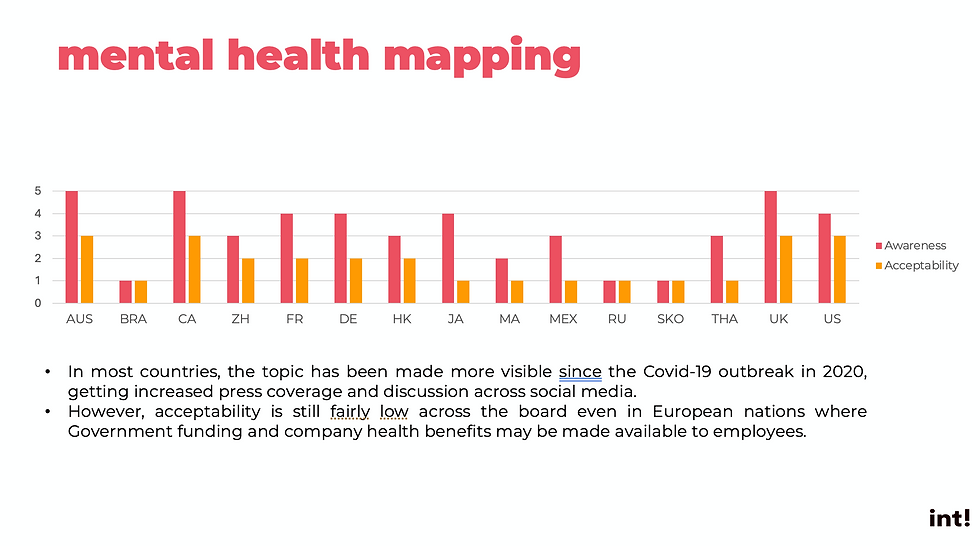
We devised a bespoke diversity mapping programme aiming to assess the levels of awareness and acceptability towards various DE&I topics across 15 of their key markets. It would inform the content of the survey, support the analysis of its results and complement some of the local market initiatives and action plan.
output
A detailed per market report was produced to support local initiatives.
A consolidated cross-market report helped inform the survey content and later-on analysis of the survey results.
And targeted recommendations were drafted for each of the DE&I themes.
reach
(AU) Australia
(BR) Brazil
(CA) Canada
(CN) China
(FR) France
(DE) Germany
(HK) Hong Kong
(JP) Japan
(MY) Malaysia
(MX) Mexico
(RU) Russia
(KR) South Korea
(TH) Thailand
(UK) United Kingdom
(US) United States


impact
The objective of our global DE&I survey was to get an accurate view of the current levels of inclusion and also give employees an opportunity to voice their opinion in terms of priorities. The main challenges we faced were to ensure the cultural relevance and adaptability of the survey and to find ways to reach each population of our organisation across 15 key markets from retail to offices and factories. The cultural mapping tool informed our approach, and provided all the insights and targeted cultural nuances to make this a two-way conversation, which in turn enabled us to build a solid action plan. The acceptability index was particularly helpful to shape the analysis of the data we gathered from around the world. A true qualitative lens on quantitative data that can otherwise be misinterpreted. To top it off, the participation rate was very high.
Aurélie Uricher,
Group Diversity, Equity and Inclusion & Internal Communcations Director


case study